Competitive Analysis
Executive Summary
This analysis examines the competitive landscape for Palace—a project-scoped thinking surface designed to reduce retrieval breakdown under vague recall. The analysis covers direct PKM competitors, AI project containers, emerging agentic workflows (including Claude Code), memory frameworks, and broader market trends.
Key Finding: While multiple tools now address pieces of the retrieval problem, no single solution provides Palace’s proposed combination of: 1. Project-scoped bounded context 2. Recognition-based (not query-driven) retrieval 3. Visible source traceability from raw material to synthesis 4. Ambient operation alongside existing tools
The competitive landscape has fragmented into specialized categories, creating an opportunity for an integrative layer that connects across silos rather than creating new ones.
Table of Contents
- Market Context
- Category 1: Personal Knowledge Management Tools
- Category 2: AI Project Containers
- Category 3: AI Coding & Workflow Tools
- Category 4: Visual Thinking & Canvas Tools
- Category 5: AI Research & Discovery Tools
- Category 6: Meeting & Capture Tools
- Category 7: Agent Memory Frameworks
- Category 8: Personal AI Assistants
- Category 9: AI-Native Computer Use Agents
- Emerging Workflow Patterns
- Competitive Positioning Matrix
- Strategic Implications for Palace
- References
1. Market Context
Industry Growth
- U.S. AI knowledge management market: $3.1B in 2025, projected $68.7B by 2034 (42.9% CAGR)
- 73% of engineering teams now use AI coding tools daily (up from 41% in 2025, 18% in 2024)
- 75% of knowledge workers have used generative AI tools
- Workers using AI save 5.4% of work hours on average (2.2 hours/week)
Key Shifts in 2025-2026
- From reactive to agentic: Tools shifting from “ask me anything” to autonomous task completion
- From keywords to semantic: Vocabulary gaps in traditional keyword search driving semantic/hybrid approaches (Scholarly Kitchen, 2026)
- Context engineering emergence: Building “context engines” that synthesize organizational knowledge
- Memory as first-class primitive: Agent memory frameworks becoming critical infrastructure
- Human-led, AI-enabled teams: Productivity gains from orchestration, not substitution
- AI-native builders emerging: Workers who operate primarily through prompting, using AI agents to control their computers
The “Token Budget” Expectation
A significant framing shift occurred at GTC 2026 when Jensen Huang stated:
“If that $500,000 engineer did not consume at least $250,000 worth of tokens, I am going to be deeply alarmed.”
Huang compared not using AI tokens to “one of our chip designers who says, guess what, I’m just going to use paper and pencil. I don’t think I’m going to need any CAD tools.”
Implications: - Tokens becoming “the fourth pillar of compensation” alongside base pay, bonus, and equity - Top candidates now negotiate compute budgets during interviews - The expectation is 10x amplification through AI consumption - Nvidia targeting $2B in token spending for their engineering team
This reframes the value proposition for tools like Palace: tools that help workers consume AI more effectively become infrastructure for productivity, not just convenience features.
2. Category 1: Personal Knowledge Management Tools
2.1 Recall AI
Positioning: “Summarize anything, forget nothing”
| Aspect | Details |
|---|---|
| Core Value | AI-powered knowledge base for web content |
| Key Features | Auto-categorization, semantic search, spaced repetition, markdown export |
| Tagline | “Safely forget everything and trust that Recall will resurface it when needed” |
| Strengths | Excellent for content consumption; handles vague queries via semantic search |
| Limitations | Not project-scoped; no source traceability; consumption-focused |
Relevance to Palace: Validates the vague-recall problem. Palace differentiates via project scoping and source traceability.
2.2 Mem.ai
Positioning: “You shouldn’t have to organize your notes—the AI does it”
| Aspect | Details |
|---|---|
| Core Value | Self-organizing notes with AI |
| Funding | $23.5M from OpenAI Startup Fund |
| Key Features | Auto-organization, AI-powered drafting, integration with Notion/Evernote |
| Strengths | Zero-maintenance organization; good for high-volume note-takers |
| Limitations | Individual-focused; limited synthesis support; no visual retrieval |
Relevance to Palace: Validates passive accumulation problem. Palace’s recognition-based browsing offers alternative to pure AI organization.
2.3 Notion AI
Positioning: Flexible knowledge platform with semantic search
| Aspect | Details |
|---|---|
| Core Value | All-in-one workspace with AI enhancement |
| Key Features | Enterprise search in natural language, multi-source integration (Slack, Drive, Asana), AI content generation |
| Strengths | Team collaboration; works out-of-box; broad ecosystem |
| Limitations | Structure-dependent organization; users report maintenance burden at scale |
Relevance to Palace: User interviews confirm Notion’s organizational fragility over time. Palace’s bounded project context addresses drift problem.
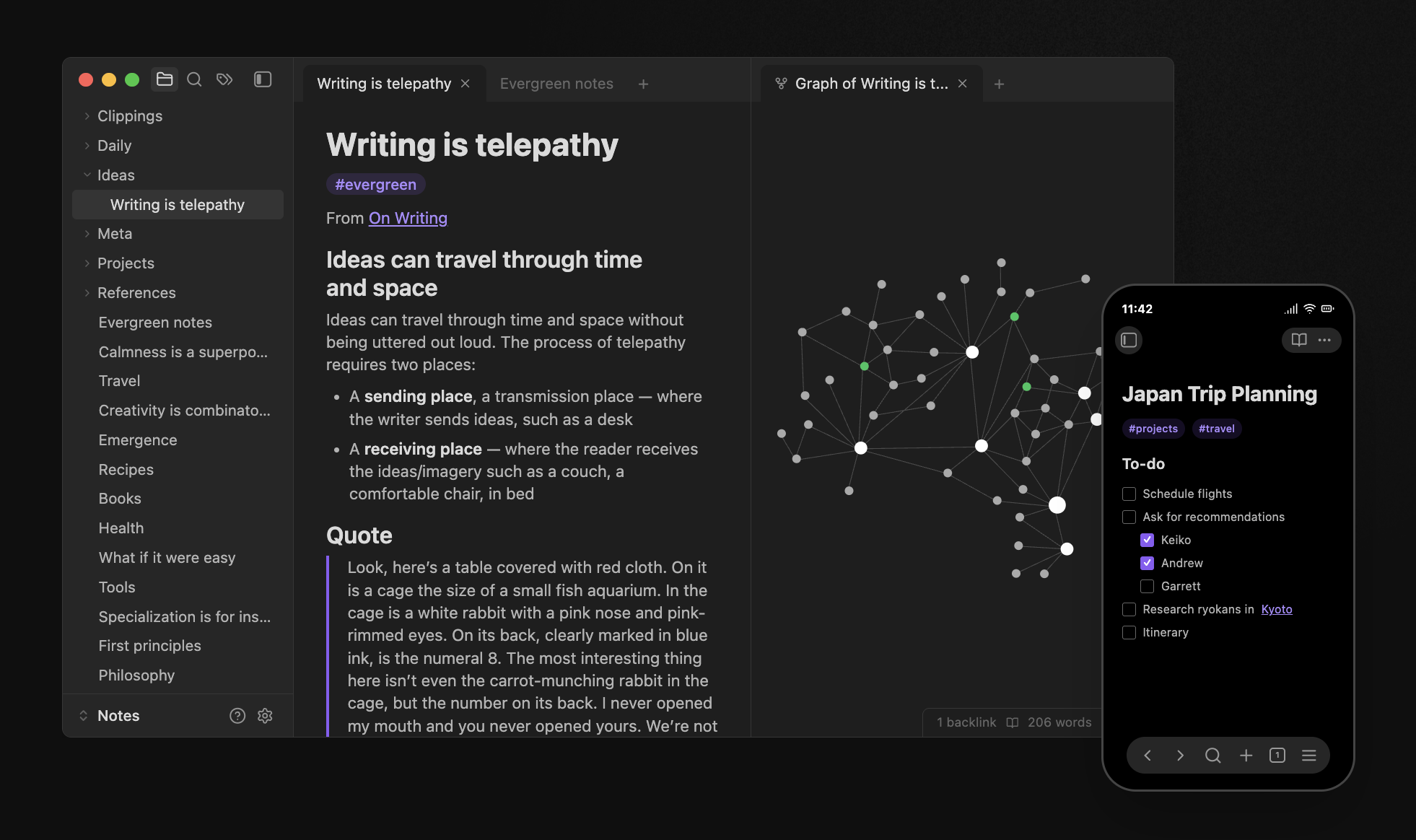
2.4 Obsidian
Positioning: Local-first markdown knowledge base
| Aspect | Details |
|---|---|
| Core Value | Maximum control, privacy, flexibility |
| 2026 Consensus | Reddit’s preferred tool for PKM power users |
| Key Features | Graph view, Canvas feature, plugin ecosystem, local storage |
| Strengths | Longevity; ownership; bidirectional linking |
| Limitations | Steep learning curve; setup investment required; mobile limitations |
Relevance to Palace: Interview participant abandoned Obsidian due to “tag inconsistency” and “clunky UI.” Palace must be lower-friction.
3. Category 2: AI Project Containers
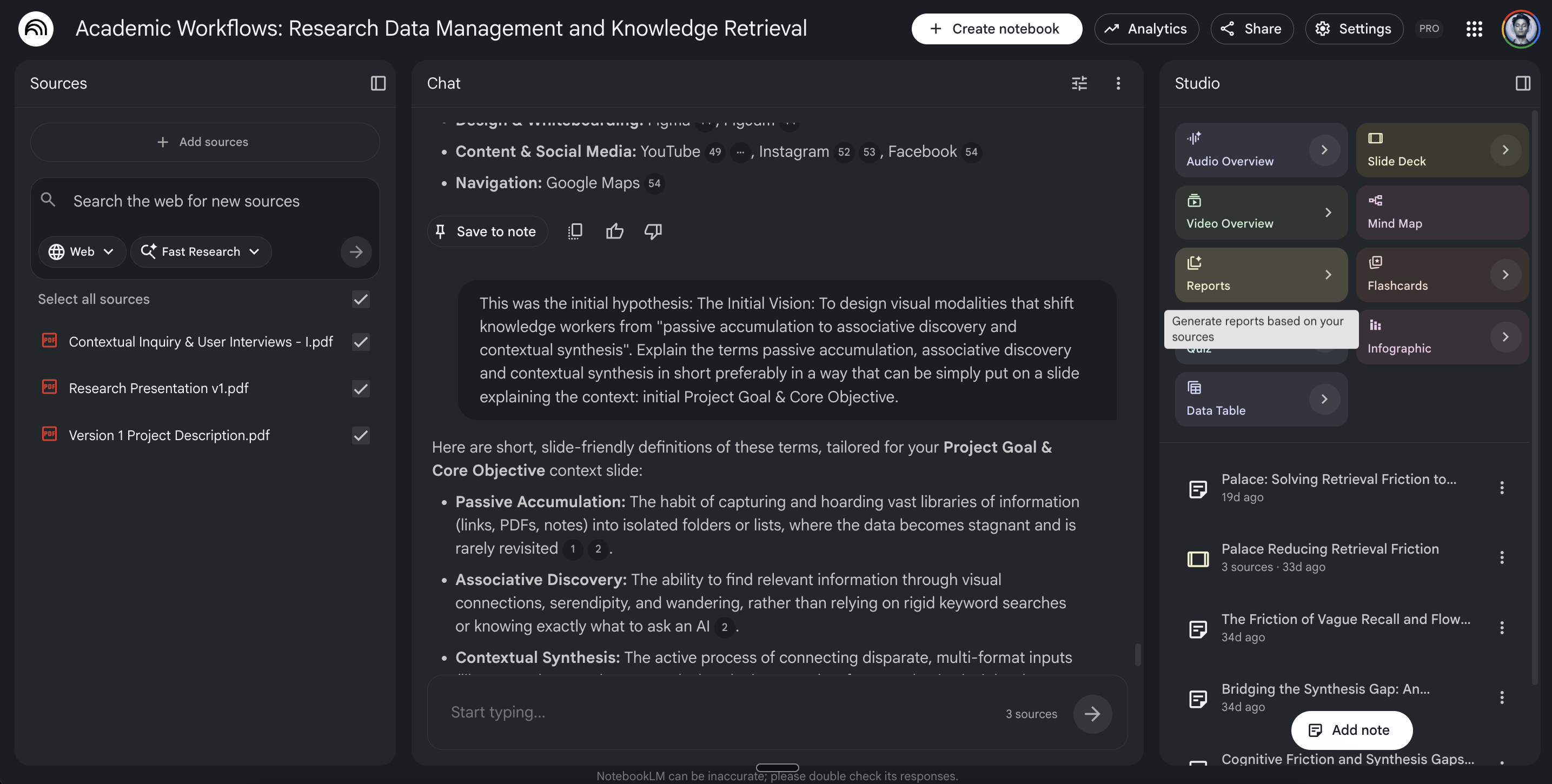
3.1 NotebookLM (Google)
Positioning: Research assistant with podcast generation
| Aspect | Details |
|---|---|
| Pricing | Free (Plus tier at $19.99/mo with Google One AI) |
| Key Features | Document upload, YouTube/webpage ingestion, podcast generation, interactive Q&A |
| Strengths | Accepts diverse media; beloved podcast feature; free tier |
| Limitations | Requires manual upload; creates new silo; no ambient integration |
Gap for Palace: NotebookLM lacks organizational features. Users must recreate context for each notebook.
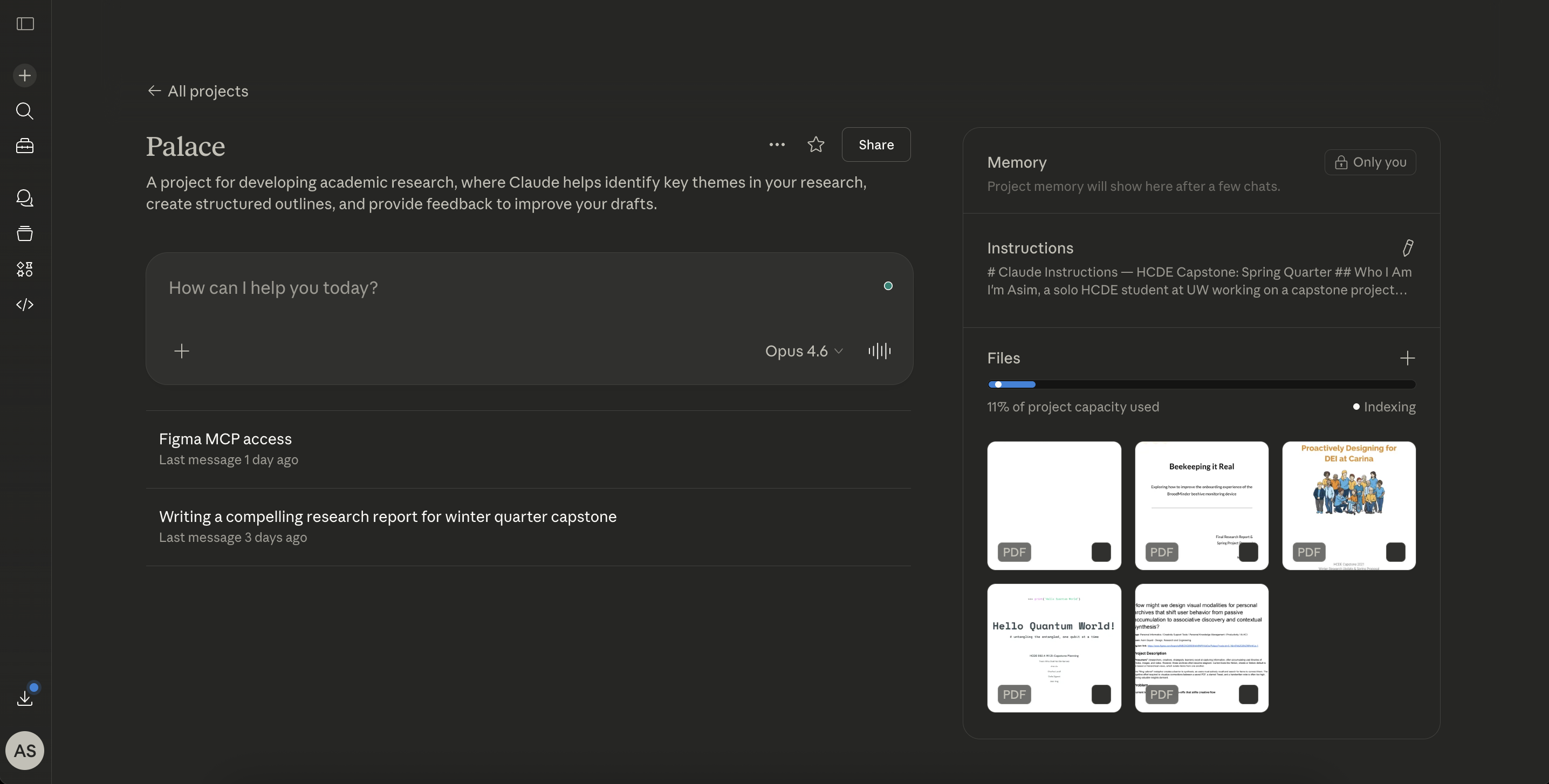
3.2 Claude Projects (Anthropic)
Positioning: Organized workspaces for research and synthesis
| Aspect | Details |
|---|---|
| Pricing | Free tier (5 projects); Pro for unlimited |
| Key Features | File uploads, context persistence across chats, thematic summaries |
| Strengths | Long document handling; superior for unorganized notes; structured responses |
| Limitations | Requires manual curation; reactive “ask me” model; no visual browsing |
Gap for Palace: Claude Projects excels at synthesis but doesn’t support recognition-based retrieval or source traceability.
3.3 ChatGPT Projects (OpenAI)
Positioning: Knowledge bases for chat context
| Aspect | Details |
|---|---|
| Pricing | $20/month+ (no free tier) |
| Key Features | PDF/document upload, project-scoped chat |
| Strengths | Simple; concise responses |
| Limitations | Files only (no web/YouTube); less detailed than Claude |
Gap for Palace: Same reactive model limitations as Claude Projects.
Cross-Category Insight
All AI containers share structural limitations: - Operate reactively (user must know what to ask) - Require manual source curation - Create new silos rather than integrating across tools - Don’t support “wandering” or recognition-based discovery
Palace’s design principles directly address these gaps.
4. Category 3: AI Coding & Workflow Tools
Why This Category Matters for Palace
User interviews revealed knowledge workers now use AI coding tools (Claude Code, Cursor) as part of their research and synthesis workflows. P2 specifically mentioned “Claude Code for side projects.” Understanding how developers integrate AI into workflow reveals patterns Palace should consider.
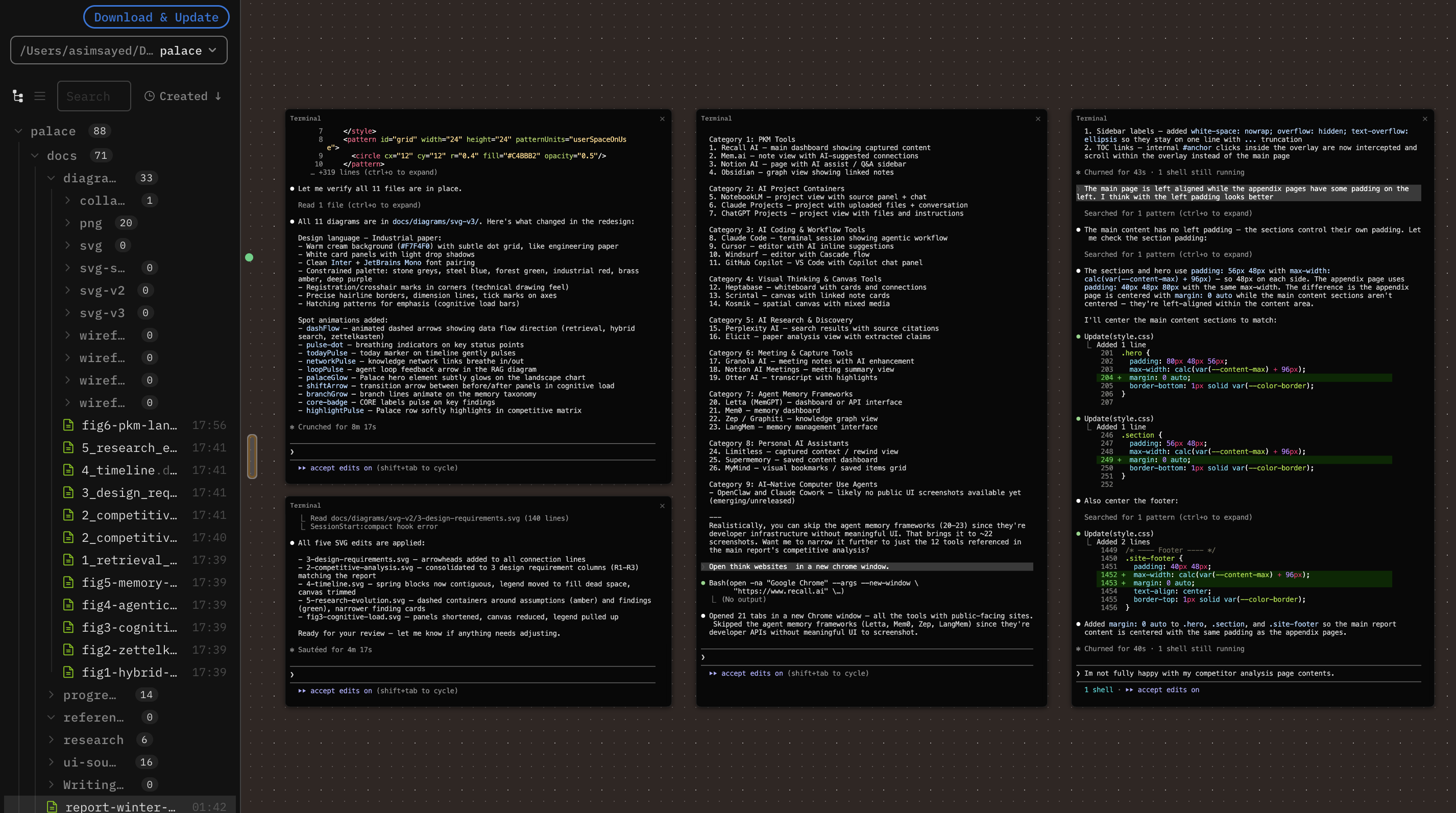
4.1 Claude Code (Anthropic)
Positioning: Agentic terminal-based coding assistant
| Aspect | Details |
|---|---|
| Launch | Early 2026 |
| Key Innovation | CLAUDE.md files for project context; auto-memory; Skills system |
| Adoption | 44% top choice for complex tasks; 31% for autocomplete |
Workflow Patterns Relevant to Palace:
- CLAUDE.md as Project Context
- Teams maintain a CLAUDE.md in git documenting “mistakes” and “best practices”
- Knowledge from each PR is preserved across sessions
-
Auto-memory saves learnings like build commands and debugging insights
-
Plan-Then-Execute
- Start with plan, refine iteratively, then auto-execute
-
“A good plan is really important!”
-
Skills as Persistent Workflows
- Repeatable instructions that persist across sessions
- Automatically applied to specific task types
Implications for Palace: - Project context files (like CLAUDE.md) model how bounded context could work - Skills pattern suggests value of persistent project “defaults” - Auto-memory demonstrates lightweight context accumulation
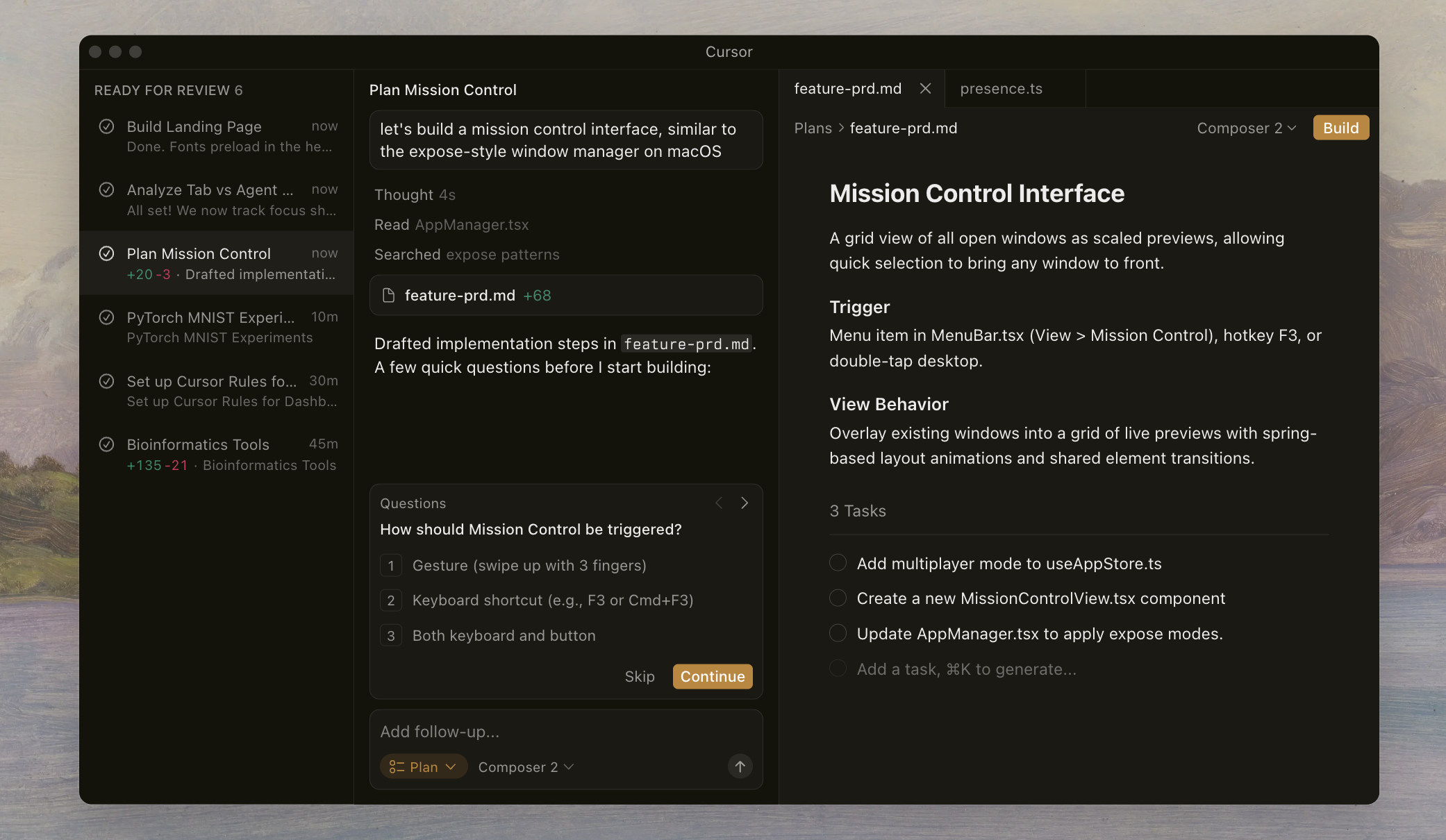
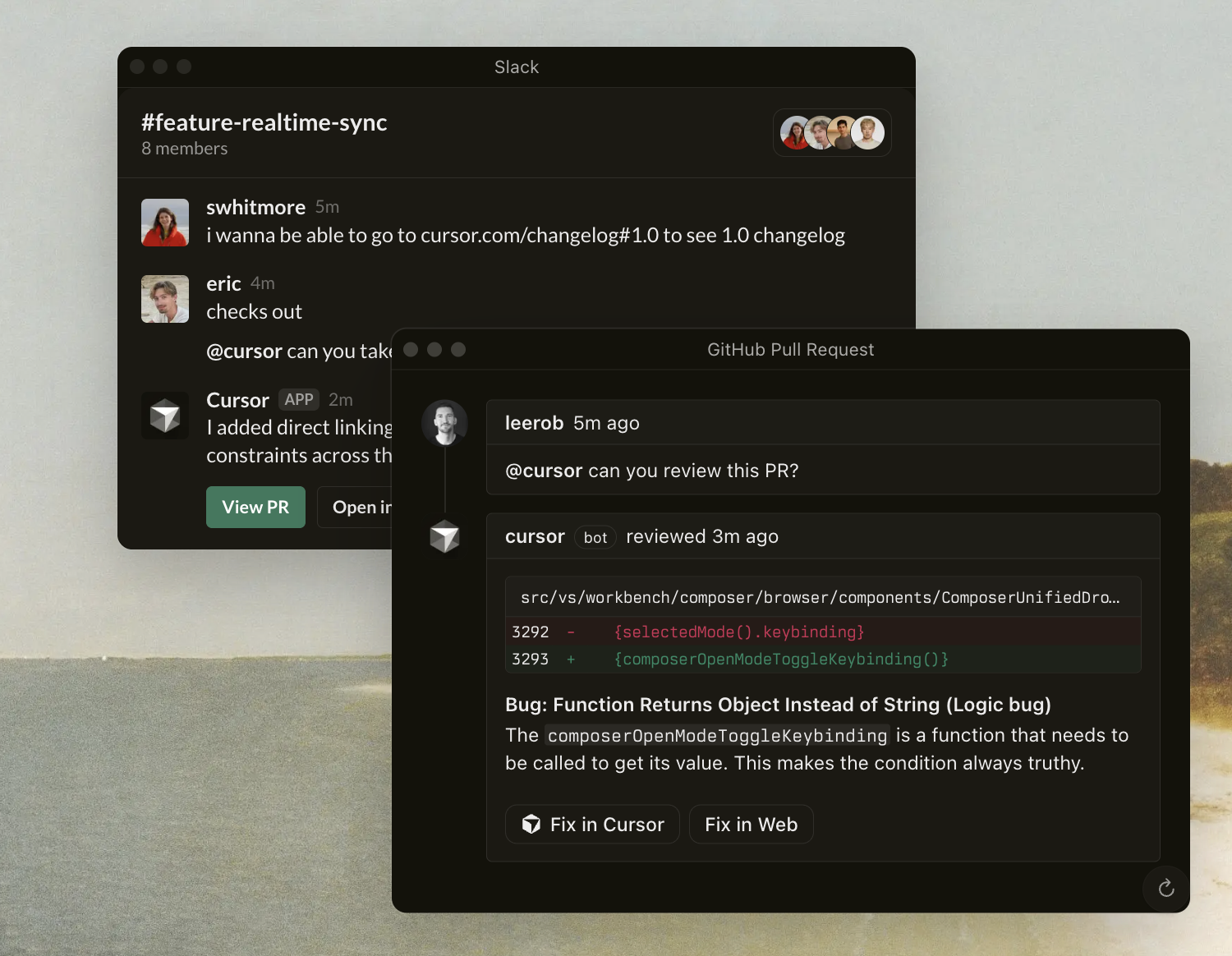
4.2 Cursor
Positioning: AI-native IDE for complex codebases
| Aspect | Details |
|---|---|
| Revenue | Crossed $1B ARR in under two years |
| Pricing | $20/mo (Pro), up to $200/mo (Max) |
| Key Features | Composer workflow, multi-file reasoning, Background Agents |
Relevance: Cursor’s success shows demand for AI that understands project-scale context.
4.3 Windsurf
Positioning: Autonomous agentic workflows
| Aspect | Details |
|---|---|
| Ranking | #1 in LogRocket AI Dev Tool Power Rankings (Feb 2026) |
| Pricing | $15/mo (best value) |
| Unique Feature | “Memories” that persist across sessions |
Relevance: Windsurf’s Memories feature parallels Palace’s persistent project context goal.
4.4 GitHub Copilot
Positioning: Universal AI coding assistant
| Aspect | Details |
|---|---|
| Scale | 4.7M paid subscribers; 90% Fortune 100 adoption |
| Key Feature | Copilot Coding Agent—assigns issues directly to AI |
| Reach | Works across VS Code, JetBrains, Xcode, Neovim, and more |
Emerging Pattern: Context as Competitive Advantage
The most successful AI tools in 2026 are those that maintain project context across sessions: - Claude Code’s CLAUDE.md and auto-memory - Windsurf’s Memories - Cursor’s Background Agents
This validates Palace’s “persistent project context” design principle.
5. Category 4: Visual Thinking & Canvas Tools
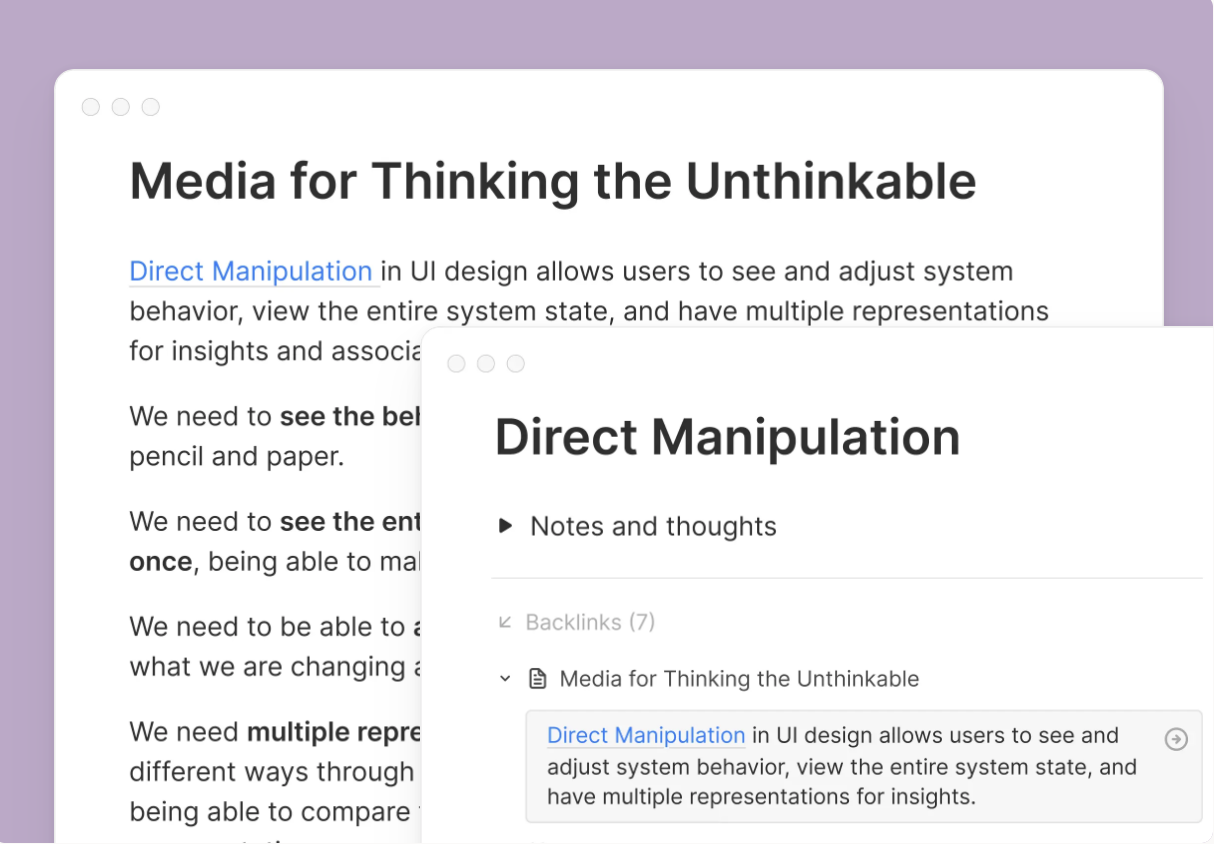
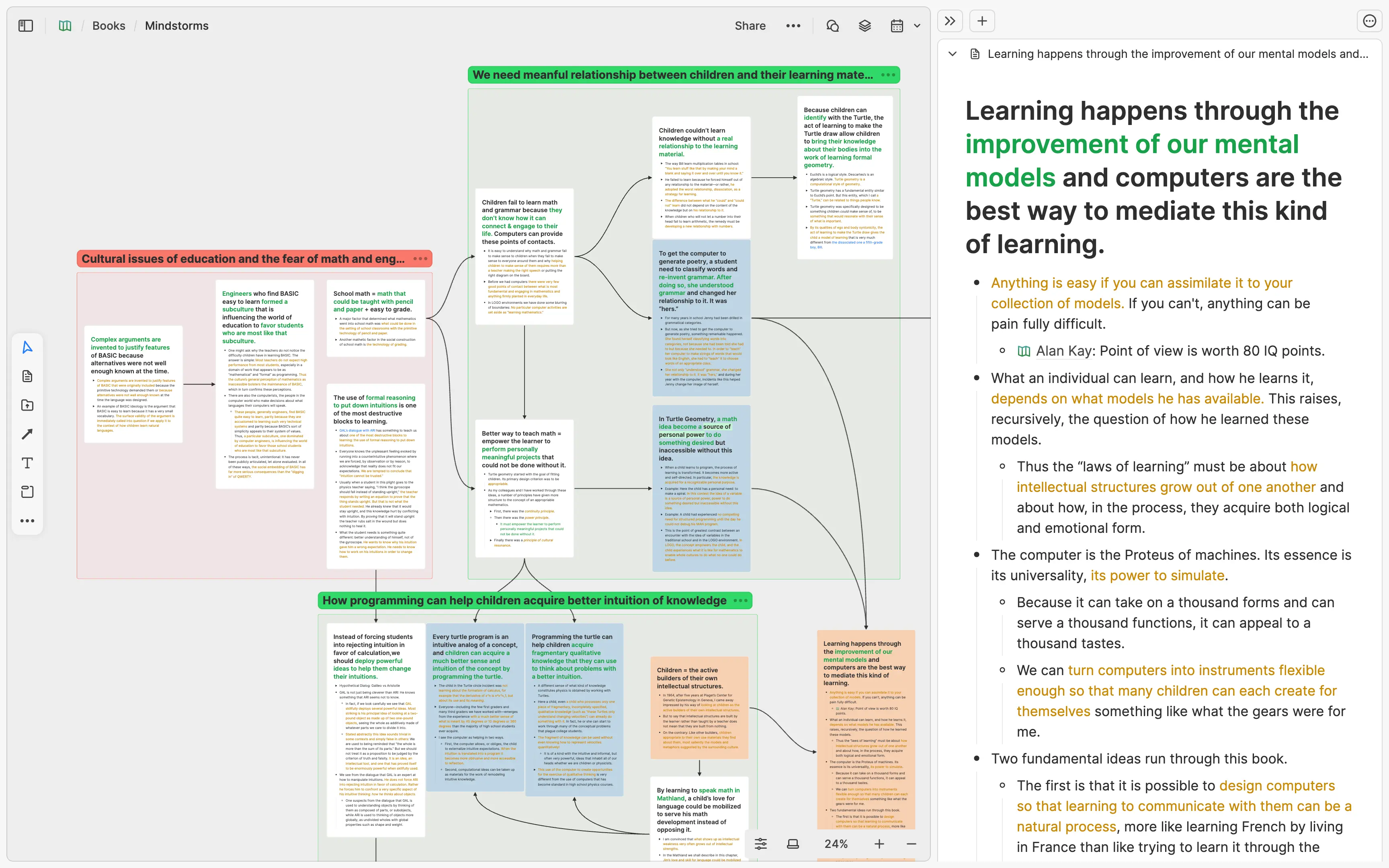
5.1 Heptabase
Positioning: “Second Brain for visual thinkers”
| Aspect | Details |
|---|---|
| Core Value | Infinite whiteboard + deep note-taking |
| Target Users | Researchers, academics, complex thinkers |
| Key Innovation | Zoom from atomic cards to big-picture view |
| Strengths | PDF annotation; literature review support; spatial organization |
| Limitations | No mobile app; single-user focused |
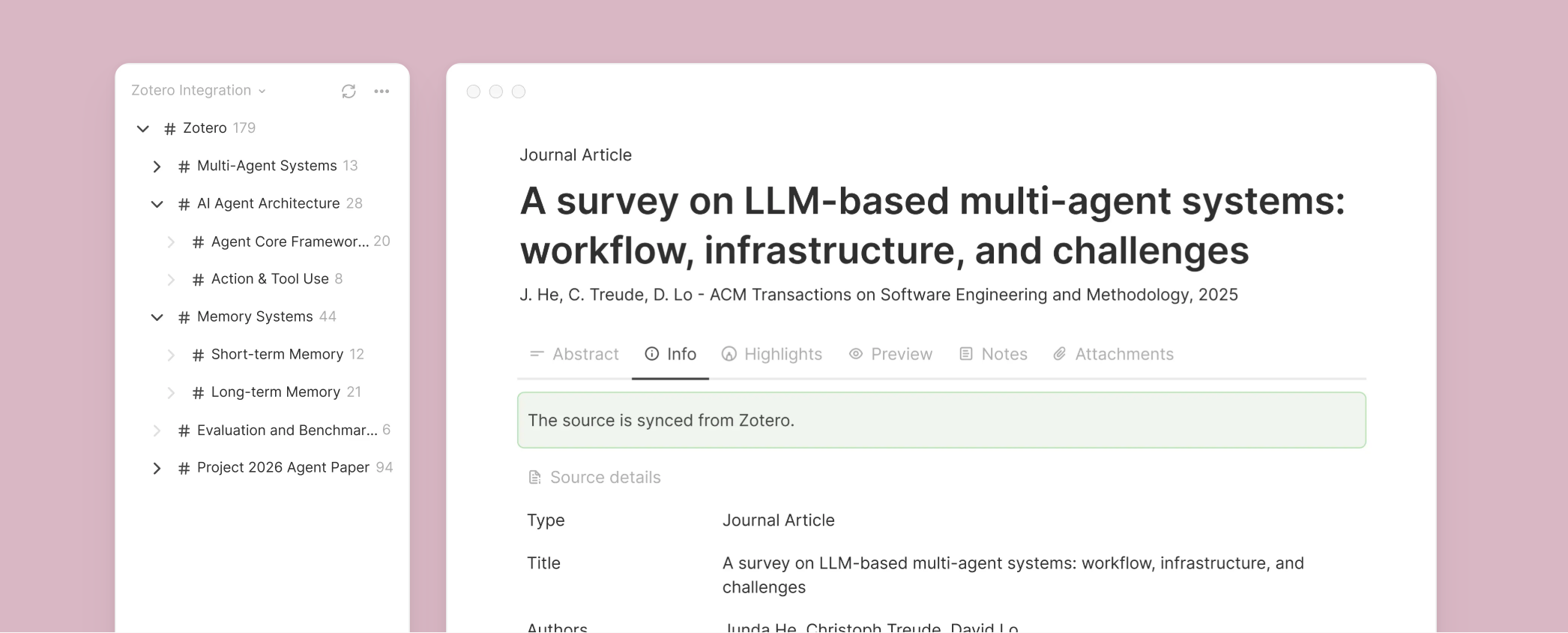
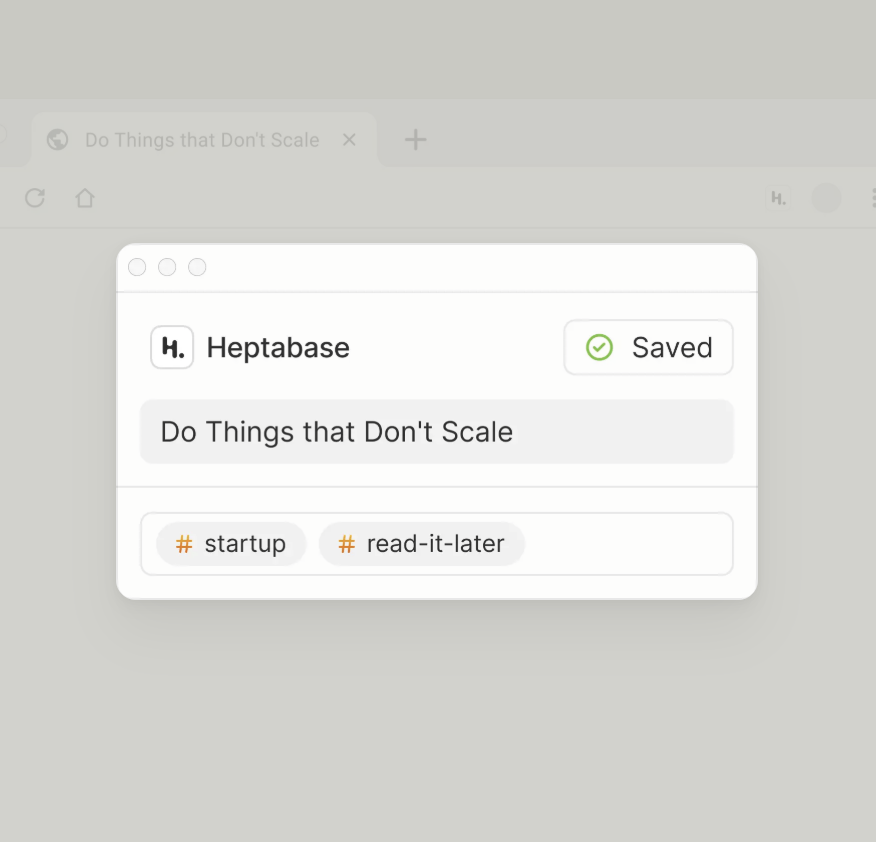
Relevance to Palace: Validates spatial/visual modality for retrieval. Palace could adopt visual browsing without requiring full Heptabase-style migration.
5.2 Scrintal
Positioning: Canvas-based PKM for teams
| Aspect | Details |
|---|---|
| Unique Value | Visual bidirectional links; team collaboration |
| Strengths | Great for “messy early stages”; cards expand to full documents |
| Limitations | No mobile; performance degrades at 100+ cards |
Relevance to Palace: Scrintal’s approach to visualizing connections between concepts aligns with Palace’s recognition-based retrieval.
5.3 Kosmik
Positioning: Collaborative visual workspace
| Aspect | Details |
|---|---|
| Unique Feature | Built-in browser for inline research |
| Strengths | AI-powered tagging; real-time collaboration; PDF annotation |
Category Insight
Visual tools validate the hypothesis that spatial organization supports recognition over recall. However, they require full workflow migration. Palace’s “ambient presence alongside existing tools” approach could capture visual benefits without migration cost.
6. Category 5: AI Research & Discovery Tools
6.1 Perplexity AI
Positioning: AI search engine replacing Google
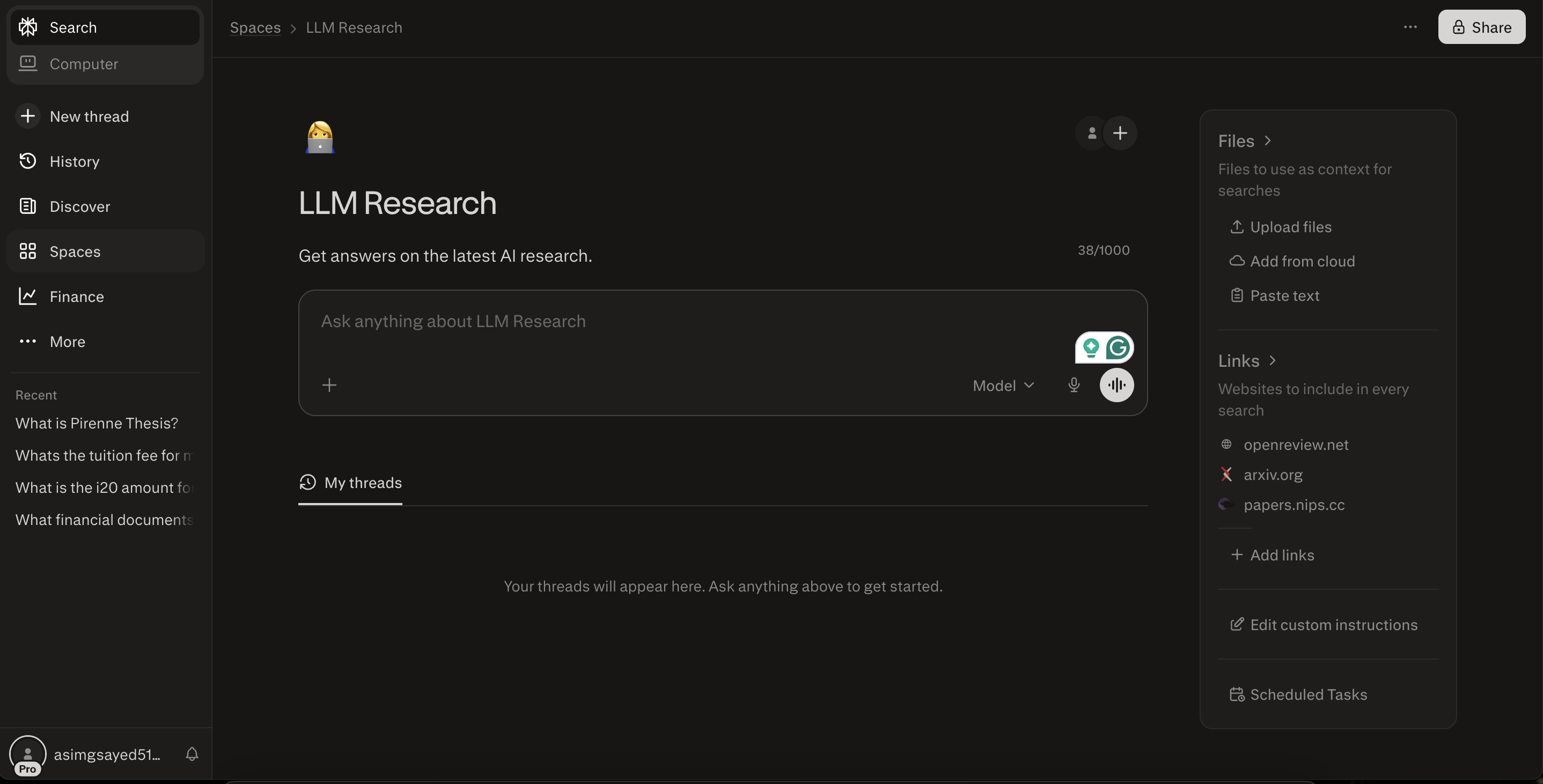
| Aspect | Details |
|---|---|
| Core Value | Conversational search with cited sources |
| 2026 Features | Model Council (compare outputs from GPT-5.2, Claude 4.6 simultaneously); Comet agentic browser |
| Best For | Quick, broad research questions with citations |
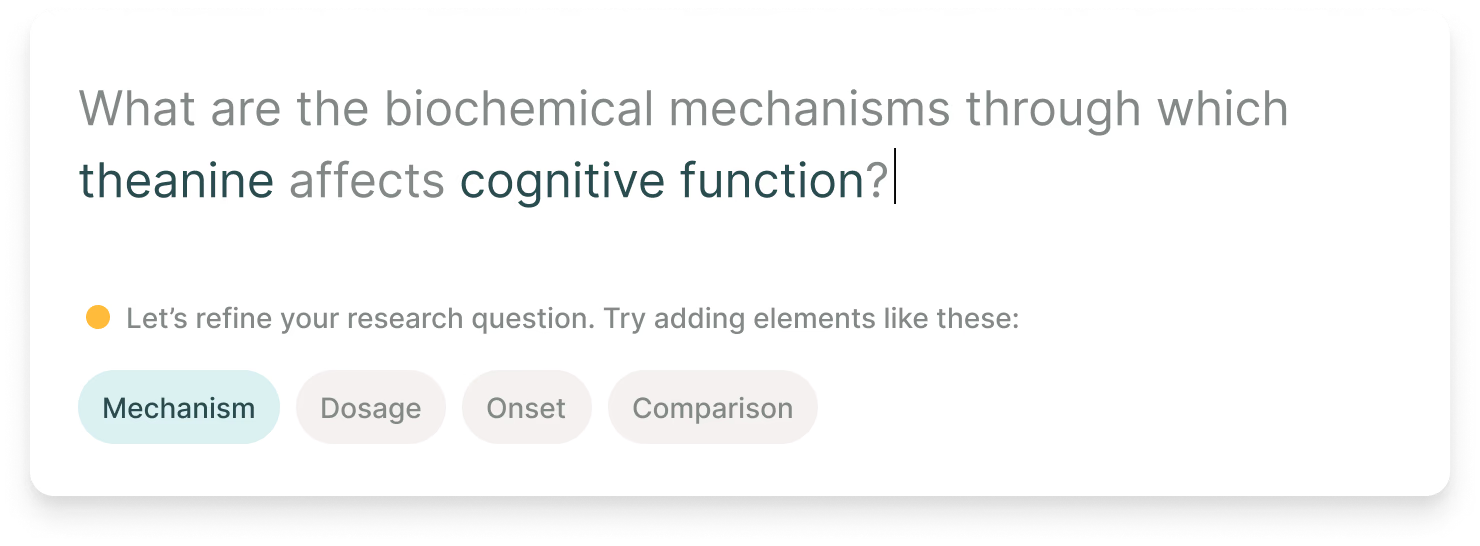
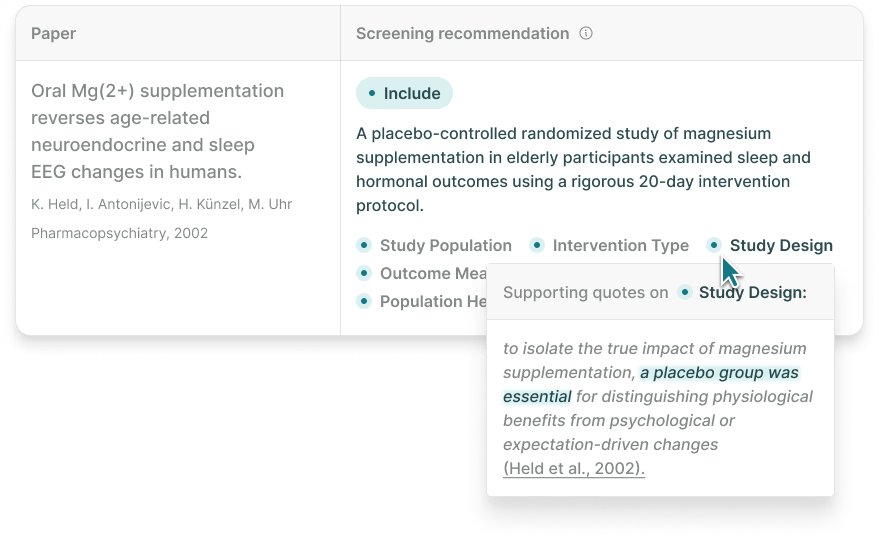
6.2 Elicit
Positioning: AI research assistant for academic work
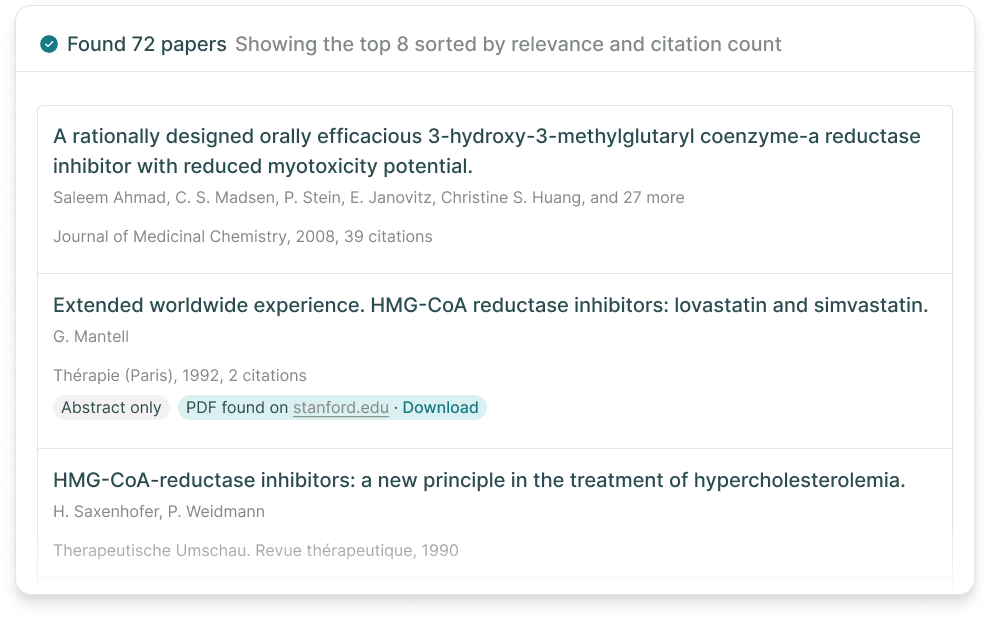
| Aspect | Details |
|---|---|
| Access | 125M+ academic papers |
| Key Features | Automated screening, data extraction, methodology assessment |
| Best For | Structured literature reviews; scientific research |
Category Insight
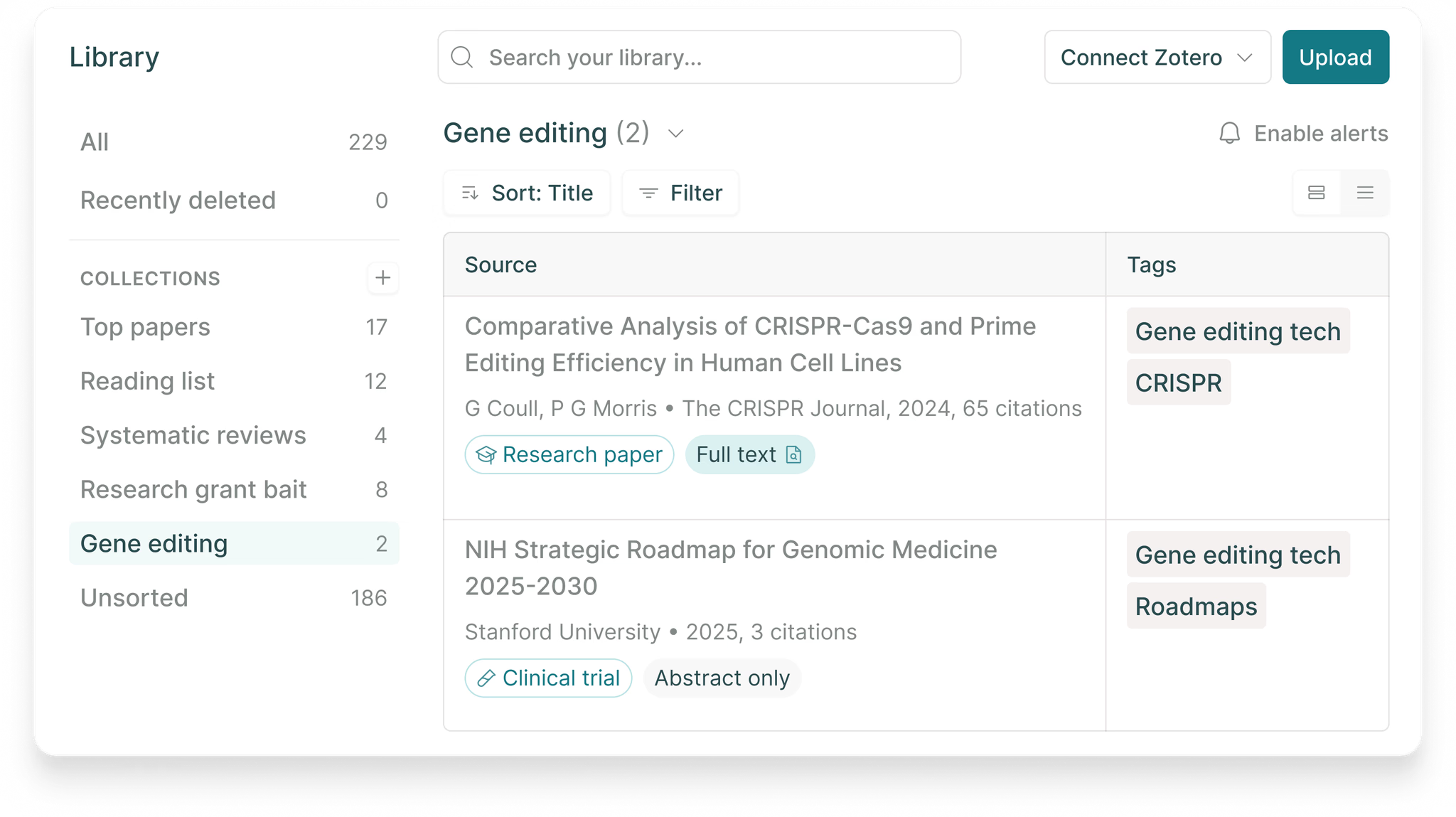
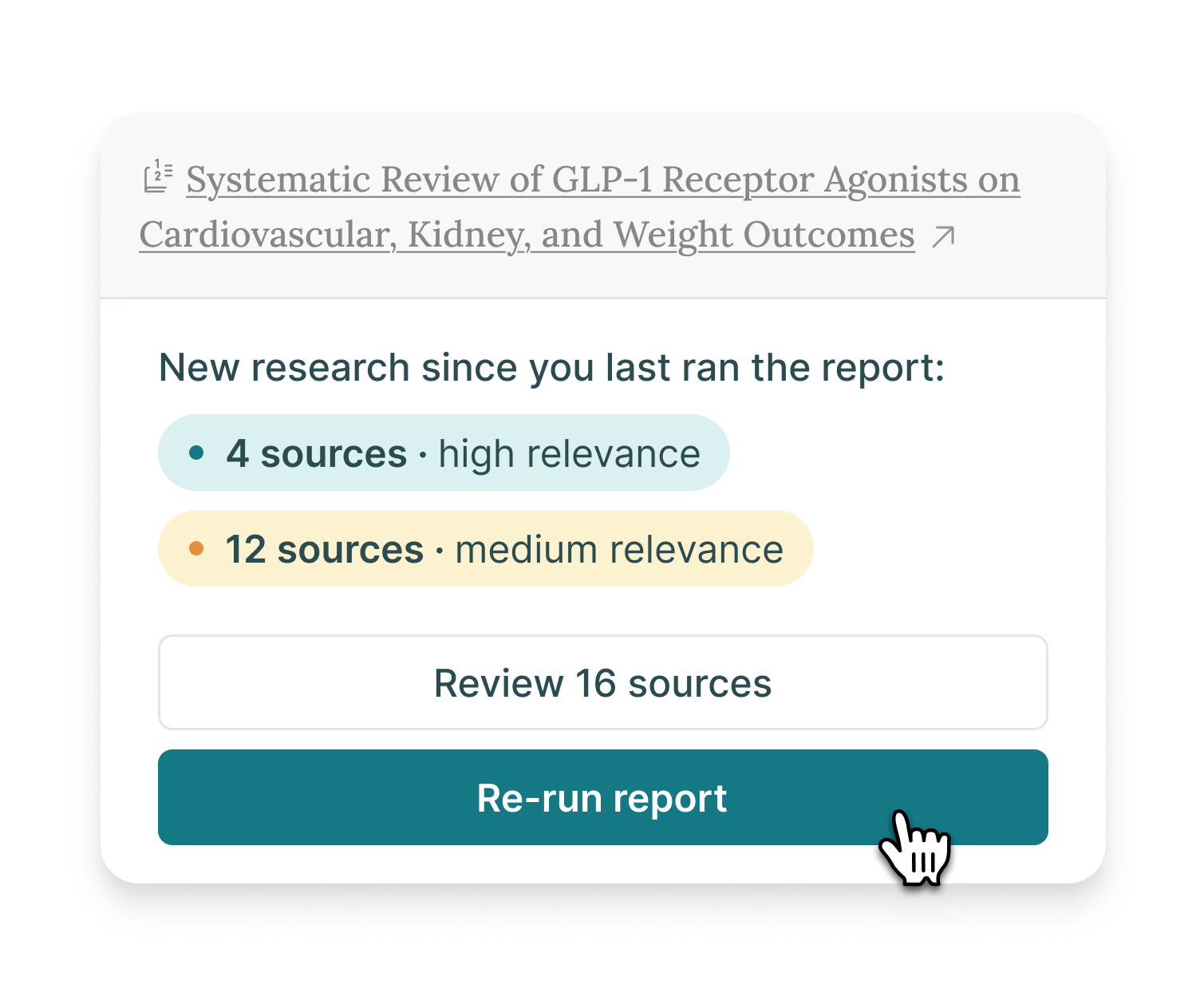
These tools solve discovery, not retrieval of personal archives. Palace addresses the gap between consuming external research and retrieving one’s own accumulated materials.
7. Category 6: Meeting & Capture Tools
7.1 Granola AI
Positioning: Bot-free meeting notes
| Aspect | Details |
|---|---|
| Pricing | $20/mo/user |
| Key Innovation | Quiet system audio capture; hybrid human+AI notes |
| Strengths | Best transcript accuracy; high-stakes meeting capture |
| Limitations | Difficult export; limited integrations |
Relevance to Palace: Interview participant P2 uses Granola. Meeting notes become another fragmented source. Palace could aggregate these artifacts.
7.2 Notion AI Meetings
Positioning: Transcription integrated into workspace
| Aspect | Details |
|---|---|
| Cost | +$10/mo on existing Notion subscription |
| Key Feature | Notes directly into Notion pages; connected to tasks/docs |
7.3 Otter AI
Positioning: Classic transcription tool
| Aspect | Details |
|---|---|
| Best For | Personal recordings; casual use |
| Limitation | Uses visible bot; less business-appropriate |
Category Insight
Meeting tools excel at capture but create yet another silo. Notes live in Granola/Otter/Notion but aren’t connected to other project materials.
8. Category 7: Agent Memory Frameworks
Why This Matters
Academic research and industry practice have converged on memory as a core primitive for AI agents. Palace’s design should consider these architectural patterns.
8.1 Letta (formerly MemGPT)
Positioning: OS-inspired memory management for agents
| Aspect | Details |
|---|---|
| Funding | $10M |
| Architecture | Tiered memory: core (always in context), archival (long-term), conversation (past interactions) |
| Key Innovation | Agents actively manage their own memory through tool calls |
Relevance: Letta’s tiered architecture could inform how Palace manages project context—what stays “hot” vs. archived.
8.2 Mem0
Positioning: Framework-agnostic agent memory
| Aspect | Details |
|---|---|
| Funding | $24M Series A (Oct 2025) |
| Performance | 67.13% accuracy on LOCOMO benchmark; 0.2s p95 latency; 90%+ token savings |
| Integrations | LangChain, CrewAI, LlamaIndex |
8.3 Zep / Graphiti
Positioning: Temporal knowledge graph for conversations
| Aspect | Details |
|---|---|
| Key Innovation | Bi-temporal modeling (when events occurred + when ingested) |
| Best For | Time-sensitive domains; tracking fact changes over time |
Relevance: Palace could benefit from temporal awareness—tracking when materials were added, accessed, or became stale.
8.4 LangMem
Positioning: Memory for LangGraph agents
| Aspect | Details |
|---|---|
| Memory Types | Semantic (facts), Episodic (examples), Procedural (behaviors) |
| Limitation | High latency (59s p95)—better for batch than real-time |
Framework Selection Principles
| Need | Recommended Approach |
|---|---|
| Personalization | Vector-first (LangMem, SuperMemory) |
| Temporal reasoning | Zep/Graphiti |
| Agent-managed memory | Letta |
| Low latency, broad integration | Mem0 |
9. Category 8: Personal AI Assistants
9.1 Limitless (formerly Rewind AI)
Positioning: Wearable-enabled personal AI
| Aspect | Details |
|---|---|
| Product | macOS app + wearable pendant |
| Key Features | Real-time transcription, automated summaries, action item extraction |
| Privacy | Local storage, encrypted |
| Limitation | macOS only (Windows beta, iOS limited) |
9.2 Supermemory
Positioning: Long-term memory API for AI apps
| Aspect | Details |
|---|---|
| Use Case | Adding persistent memory to voice agents, user sessions |
| Key Feature | Memory graph grows and connects context across projects |
9.3 MyMind
Positioning: Minimalist capture without organization
| Aspect | Details |
|---|---|
| Philosophy | No folders, tags, or categories—just save and find |
| Strengths | Beautiful design; effortless capture |
| Limitations | Not dev-oriented; lacks project linking |
10. Category 9: AI-Native Computer Use Agents
The Paradigm Shift
“The era of conversational AI chatbots is officially giving way to the era of agentic AI—systems that don’t just talk to you, but actually do the work for you.”
This category represents a fundamental shift: instead of AI assisting within specific tools, AI operates across the entire computer, executing multi-step workflows through natural language.
10.1 OpenClaw (formerly Moltbot/Clawdbot)
Positioning: Open-source personal AI operating system
| Aspect | Details |
|---|---|
| Scale | 100,000+ GitHub stars (Feb 2026) |
| Philosophy | “Personal AI agent that doesn’t just chat, but takes actions on your behalf” |
| Key Features | 5,700+ community skills; system-wide automation; WhatsApp/Telegram integration |
| Deployment | Docker/WSL-based; runs persistently |
How It Works: - Text the AI on WhatsApp → it manages your desktop calendar and emails - Autonomous execution across devices and accounts - Community-contributed “skills” for common workflows
Limitations: - Requires more prompt engineering than Claude Code - Setup complexity (Docker/WSL) - Less out-of-box reliability
10.2 Claude Cowork (Anthropic)
Positioning: Secure desktop AI teammate
| Aspect | Details |
|---|---|
| Core Value | File and workflow automation in sandboxed environment |
| Security | Apple Virtualization Framework sandbox; folder-level permissions |
| Key Features | File organization, PDF data extraction, spreadsheet automation |
Example Workflow:
Point it at a messy “Downloads” folder and tell it to organize files by type, rename them, and extract data from receipt PDFs into an Excel spreadsheet.
New Feature: Claude Dispatch (March 2026) - Send instructions from your phone - Claude executes tasks on your desktop while you’re away - Async task delegation model
10.3 Comparison: OpenClaw vs Claude Cowork vs Claude Code
| Dimension | OpenClaw | Claude Cowork | Claude Code |
|---|---|---|---|
| Scope | System-wide, cross-platform | Desktop files/workflows | Code repositories |
| Philosophy | Personal AI OS | Digital teammate | Coding partner |
| Autonomy | Highest (persistent, proactive) | Medium (sandboxed, reactive) | High (within repo) |
| Best For | Life automation, 24/7 agent | Document/file workflows | Software development |
| Setup | Docker/WSL required | Desktop app | Terminal-based |
10.4 The “AI-Native Builder” Profile
A new worker archetype is emerging: people who operate primarily through prompting rather than direct manipulation.
Characteristics: - Default to describing tasks rather than executing them - Comfortable delegating multi-step workflows to agents - Think in terms of “what outcome” not “what steps” - Invest in prompt engineering as a core skill - Manage a “fleet” of specialized agents for different domains
Workflow Example:
Morning: Check WhatsApp messages → OpenClaw has triaged emails, updated calendar
Work: "Research X topic, compile sources" → Claude Projects synthesizes
Coding: "Implement feature Y" → Claude Code executes in repo
Files: "Organize client deliverables" → Claude Cowork handles downloads folder
10.5 Implications for Palace
The Challenge: If workers increasingly operate through AI agents, retrieval becomes agent-mediated rather than human-directed. The agent needs to: 1. Know what sources exist (context awareness) 2. Retrieve relevant materials (semantic + relational) 3. Maintain traceability (what source supported what claim)
Palace’s Opportunity: - Serve as the project context layer that agents query - Provide structured memory for multi-agent workflows - Enable recognition-based browsing when human wants to verify/explore - Maintain source traceability that agents often lose
Design Question:
Should Palace be human-facing, agent-facing, or both? The AI-native builder may want Palace to be queryable by their Claude Code/Cowork agents, not just browsable by humans.
11. Emerging Workflow Patterns
10.1 How People Actually Use Claude Code
From user research and industry observation:
- CLAUDE.md as Living Documentation
- Teams document architectural decisions, coding standards, common mistakes
-
Knowledge accumulates across sessions without explicit “saving”
-
Plan Mode → Execute Mode
- Users refine plans iteratively before auto-execution
-
Validates Palace’s design question about “planning” as a retrieval precursor
-
Skills as Encoded Workflows
- Persistent instructions applied to task types
-
Parallels Palace’s potential for project-specific retrieval behaviors
-
Multi-Agent Orchestration
- Lead agent spawns specialized sub-agents
- Knowledge work becoming “coordination” rather than solo execution
10.2 The Context Engineering Shift
From QCon London 2026: “Context engineering is becoming a critical tool for unlocking the value of AI.”
A context engine: - Synthesizes organizational knowledge across disparate sources - Maintains identity-scoped permissions - Personalizes results based on who’s asking - Searches globally before reasoning
This describes exactly what Palace aims to provide at the individual/project level.
10.3 The “Frontier Firm” Model
Microsoft 2025 Work Trend Index predicts: - Traditional org charts replaced by “Work Charts” - Teams form around goals, not functions - Like movie production: tailored teams assemble for projects
Implication: Project-scoped tools (like Palace) align with where enterprise work is heading.
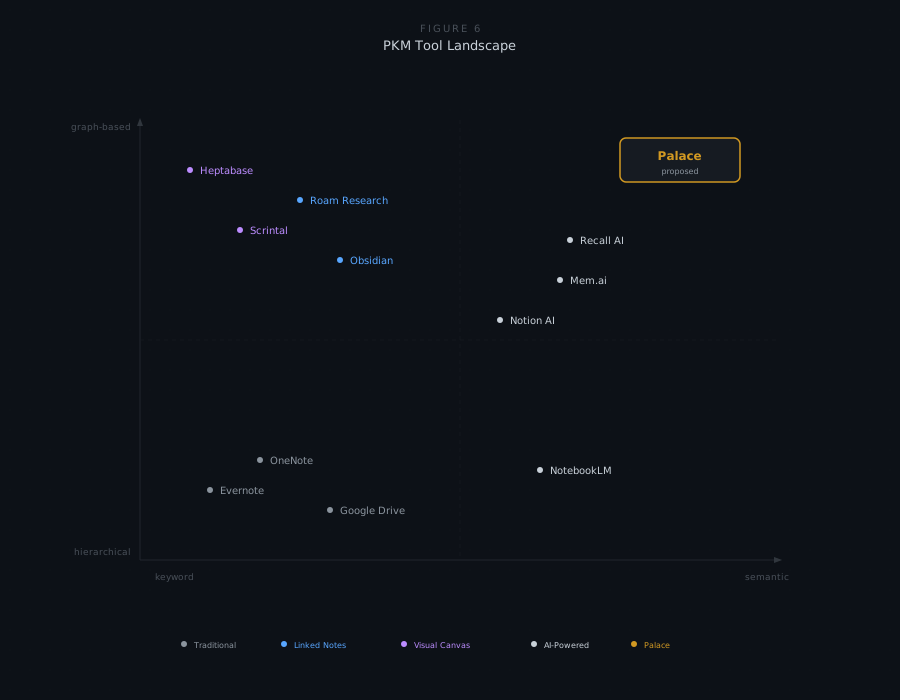
12. Competitive Positioning Matrix
By Retrieval Approach
| Tool | Retrieval Mode | Project Scoping | Source Traceability | Visual/Recognition | Ambient Operation |
|---|---|---|---|---|---|
| Palace (proposed) | Recognition-based | Yes | Yes | Yes | Yes |
| NotebookLM | Query-driven | Per-notebook | Partial | No | No |
| Claude Projects | Query-driven | Yes | Partial | No | No |
| Recall AI | Semantic search | No (global) | No | No | Yes |
| Mem.ai | AI-organized | No | No | No | Yes |
| Heptabase | Visual/spatial | Optional | Yes | Yes | No |
| Notion AI | Hybrid | Workspaces | Partial | Limited | Partial |
By Problem Addressed
| Problem | Palace Solution | Best Current Alternative |
|---|---|---|
| Vague recall retrieval | Recognition-based browsing | Recall AI (semantic) |
| Multi-tool fragmentation | Ambient integration layer | None (tools create silos) |
| Source traceability | Visible idea→source chains | Heptabase (requires migration) |
| Organizational decay | Bounded project context | Mem.ai (global, not project) |
| Flow disruption | In-context retrieval | Notion AI (partial) |
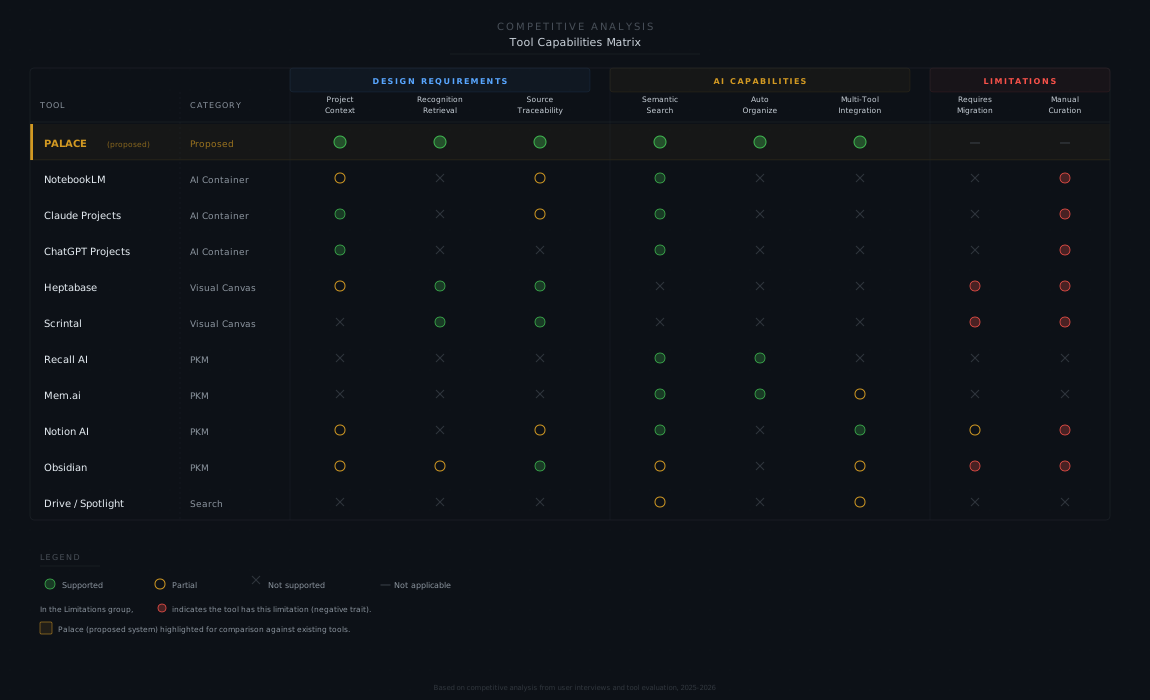
13. Strategic Implications for Palace
13.1 Validated Design Principles
| Principle | Validation Source |
|---|---|
| Support Recognition Over Recall | Semantic search adoption; vocabulary gap research; Heptabase/Scrintal success |
| Preserve Persistent Project Context | Claude Code’s CLAUDE.md; 19x enterprise growth in project tools; Windsurf’s Memories |
| Maintain Visible Source Traceability | A-MEM Zettelkasten approach; faithfulness metrics in agentic evaluation; user interview findings on synthesis artifacts |
| Reduce Context Switching | CHI 2025 “Tools for Thought” research; Granola’s in-context design; user interview pain points |
13.2 Competitive White Space
Palace’s unique positioning lies in the intersection of:
- Project-scoped (not global knowledge base)
- Recognition-based (not query-driven)
- Source-traceable (not synthesis-only)
- Ambient (operates alongside existing tools)
No current tool occupies this exact position.
13.3 Threats & Considerations
| Threat | Mitigation |
|---|---|
| NotebookLM adds project features | Palace’s ambient integration vs. NotebookLM’s upload-required model |
| Claude Projects gets visual UI | Palace’s source traceability and recognition modality |
| Notion AI becomes dominant | Palace as complement (aggregation layer) rather than competitor |
| Users resist another tool | Palace must feel like a “layer” not a “tool”—ambient presence |
13.4 Technical Approaches to Consider
Based on competitive analysis and memory framework research:
| Capability | Approach | Framework/Tool |
|---|---|---|
| Semantic search | Vector embeddings | Pinecone, Weaviate |
| Knowledge graphs | Relationship mapping | Cognee, Neo4j |
| Hybrid search | Semantic + keyword | Best practice per Scholarly Kitchen |
| Context persistence | Tiered memory | Letta architecture |
| Temporal awareness | Bi-temporal modeling | Zep/Graphiti pattern |
13.5 Open Questions for Design
1. How to avoid becoming “another dumping ground”?
Why it matters: User interviews revealed that existing tools like Notion and Google Drive accumulate materials that never resurface. Mem.ai and Recall AI attempt to solve this with AI organization, but users report “out of sight, out of mind” syndrome persists. Palace must break this pattern.
Competitive insight: Heptabase succeeds partly because its spatial canvas makes everything visible. Claude Code’s CLAUDE.md works because it’s bounded to a single repository. NotebookLM fails here—users report creating notebooks they never revisit.
Design considerations: - Bounded capture by project with explicit project lifecycle (active → archived → sunset) - Intelligent decay: surface items that haven’t been accessed in X days for review - Usage-based surfacing: track what gets retrieved vs. what sits dormant - Capacity constraints: limit items per project to force curation decisions - “Inbox zero” model: require processing new captures rather than passive accumulation
Trade-off: Stricter boundaries reduce cognitive load but may frustrate users who want flexibility. Consider progressive disclosure—simple by default, power features available.
2. How to balance semantic and keyword retrieval?
Why it matters: Vocabulary gaps between how users describe what they’re looking for and how they originally labeled/wrote it reduce keyword search effectiveness. Pure keyword search fails under vague recall. But semantic search can feel like a black box and miss exact matches.
Competitive insight: Scholarly Kitchen (2026) advocates hybrid approaches. Notion AI uses semantic search but users report frustration when it misses obvious keyword matches. Recall AI’s semantic-first approach works for consumption but struggles with precision retrieval.
Design considerations: - Hybrid ranking: weight semantic similarity and keyword matches based on query characteristics - Query intent detection: short specific queries → keyword bias; longer descriptive queries → semantic bias - Transparency: show why items were retrieved (matched keywords, semantic similarity score, relational links) - Fallback chain: semantic first → keyword fallback → browsing suggestion - User feedback loop: let users mark “this was/wasn’t what I wanted” to improve ranking
Trade-off: More sophisticated retrieval requires more compute and may introduce latency. Consider tiered approach—fast keyword scan, then semantic enrichment.
3. How to measure success without longitudinal access?
Why it matters: The 10-week capstone timeline prevents true longitudinal study of retrieval patterns. Yet Palace’s value proposition depends on demonstrating reduced retrieval breakdown over time.
Competitive insight: Memory framework benchmarks (LOCOMO, MemBench) use synthetic retrieval tasks. Heptabase relies heavily on qualitative testimonials and workflow demonstrations rather than metrics.
Design considerations: - Simulated retrieval tasks: seed test projects with known materials, measure retrieval success under vague prompts - Time-boxed comparative testing: same task with Palace vs. current tools, measure completion time and flow interruptions - Self-reported metrics: retrieval confidence ratings, perceived flow disruption, tool-switching frequency - Behavioral proxies: time-to-first-retrieval, retrieval attempt count before success/abandonment - Wizard-of-Oz testing: manually simulate ideal retrieval to validate the concept before full implementation
Trade-off: Lab-based testing may not capture real-world retrieval patterns. Consider recruiting participants to use Palace for actual projects during testing phase.
4. How to maintain source traceability as synthesis evolves?
Why it matters: User interviews revealed that synthesis artifacts (slides, docs) become disconnected from source materials. When questioned about claims, users cannot trace back to origins. This breaks trust and forces redundant research.
Competitive insight: Heptabase maintains source links through its card system. NotebookLM provides citations but only within the notebook—cross-notebook traceability doesn’t exist. Zep/Graphiti’s bi-temporal modeling tracks when facts were learned vs. when they occurred.
Design considerations: - Versioned provenance chains: each synthesis element links to source(s) with timestamp - Diff-aware linking: when sources update, flag dependent syntheses for review - Bidirectional navigation: from any synthesis, trace to sources; from any source, see all syntheses that reference it - Confidence indicators: syntheses with single sources vs. triangulated from multiple sources - Export with provenance: when sharing synthesis externally, include source metadata
Trade-off: Rich traceability adds friction to synthesis creation. Consider automatic link inference with manual override rather than requiring explicit linking.
5. Should Palace be human-facing, agent-facing, or both?
Why it matters: The emergence of AI-native builders who operate primarily through prompting fundamentally changes retrieval patterns. Jensen Huang’s “token budget” framing suggests tools must amplify AI consumption, not just human productivity. If retrieval becomes agent-mediated, Palace must be queryable by agents.
Competitive insight: Claude Code’s CLAUDE.md is effectively agent-facing—it’s context for the AI, not a human interface. Letta and Mem0 are explicitly agent memory frameworks. OpenClaw and Claude Cowork operate across the user’s entire system, potentially needing access to project context.
Design considerations: - Dual interface: visual browsing layer for humans, MCP/API layer for agent queries - Structured memory format: store context in ways that agents can efficiently query (not just human-readable prose) - Agent handoff protocol: when human retrieval fails, option to “ask Palace AI” that queries the same store - Permission model: which agents can access which project contexts? - Audit trail: track agent queries separately from human queries for debugging
Trade-off: Optimizing for agent consumption may compromise human browsability. Consider maintaining separate “views”—human-optimized visual layer, agent-optimized structured layer, same underlying data.
6. How does Palace fit into a multi-agent workflow?
Why it matters: Users increasingly operate through specialized agents—OpenClaw for life automation, Claude Code for development, Claude Cowork for file management. Palace must integrate into this ecosystem rather than compete with it.
Competitive insight: The most successful 2026 tools (Cursor, Claude Code, Windsurf) maintain project context that persists across sessions. The “context engineering” trend at QCon emphasizes synthesis across disparate sources. No current tool serves as a cross-agent project context layer.
Design considerations: - Shared context layer: Palace as the “project memory” that all agents can query - Agent-specific views: Claude Code sees code-relevant context; Cowork sees file-relevant context - Interoperability standards: MCP protocol support, standard memory formats - Conflict resolution: when multiple agents update context, how to merge? - Human oversight: dashboard showing what agents have queried/contributed to context
Trade-off: Deep integration with specific agents (Claude ecosystem) vs. broad compatibility with all agents. Consider Claude-first with extension points for others.
7. How to handle the recognition-vs-recall tension in UI design?
Why it matters: Palace’s core differentiator is supporting recognition-based retrieval. But every UI element shown adds cognitive load. The challenge is making enough visible to trigger recognition without overwhelming.
Competitive insight: Heptabase’s infinite canvas works for some users but others report “where do I even start?” paralysis. MyMind’s minimal UI supports serendipitous browsing but lacks structure. Notion’s databases provide structure but require remembering where things are filed.
Design considerations: - Adaptive density: show more context when browsing, collapse when focused on specific item - Multiple entry points: recent items, project-grouped items, visual similarity clusters, timeline view - Progressive disclosure: start with high-level themes, drill into specifics - Search-as-you-browse: typing filters visible items without switching to “search mode” - Peripheral awareness: ambient display of related items without demanding attention
Trade-off: Rich visual browsing requires screen real estate and cognitive processing. Consider contextual switching between “focus mode” (minimal) and “explore mode” (maximal).
8. What is Palace’s defensible position if incumbents add similar features?
Why it matters: NotebookLM could add project organization. Claude Projects could add visual browsing. Notion AI could improve retrieval. Palace must have defensibility beyond feature parity.
Competitive insight: Successful tools in 2026 win on workflow integration, not isolated features. Cursor won despite GitHub Copilot’s resources because it reimagined the entire coding workflow. Granola won meeting notes by eliminating the bot presence entirely.
Design considerations: - Workflow integration depth: Palace as layer across tools, not another destination - Data portability: user owns their context, can export/migrate freely (builds trust) - Customization surface: project-specific retrieval behaviors, personal organization schemes - Community/ecosystem: shareable project templates, retrieval patterns - Speed of iteration: smaller team can move faster on user feedback than Google/Anthropic/OpenAI
Strategic positioning: Palace is not “AI container + visual browsing + project scoping.” Palace is “the persistent context layer for knowledge work”—a different category than any single competitor.
14. References
Anderson, R. (2026, January 6). Keywords are not dead, but discovery is no longer just search. The Scholarly Kitchen. https://scholarlykitchen.sspnet.org/2026/01/06/keywords-are-not-dead-but-discovery-is-no-longer-just-search/
Anthropic. (2026). Eight trends defining how software gets built in 2026. Claude Blog. https://claude.com/blog/eight-trends-defining-how-software-gets-built-in-2026
Anthropic. (n.d.). Claude Code overview. Claude Code Documentation. https://code.claude.com/docs/en/overview
Anthropic. (2026). Dispatch for Claude Cowork. Quasa. https://quasa.io/media/anthropic-just-shipped-its-own-openclaw-faster-than-openai-meet-dispatch-for-claude-cowork
CodeAgni. (2026). Claude Cowork vs. Moltbot (OpenClaw) in 2026: AI tools that changed how we work. https://codeagni.com/blog-details?slug=claude-cowork-vs-moltbot-openclaw-in-2026-ai-tools-that-changed-how-we-work
Cognizant. (2026). Enterprise AI in 2026. Cognizant Insights. https://www.cognizant.com/us/en/insights/insights-blog/enterprise-ai-in-2026
Developer Survey. (2026). AI coding tool adoption hits 73%. https://claude5.ai/news/developer-survey-2026-ai-coding-73-percent-daily
Elephas. (2026). Claude Projects vs. NotebookLM 2026. Elephas Blog. https://elephas.app/blog/notebooklm-vs-claude-projects
Huang, J. (2026, March 20). Nvidia’s Huang pitches AI tokens on top of salary. CNBC. https://www.cnbc.com/2026/03/20/nvidia-ai-agents-tokens-human-workers-engineer-jobs-unemployment-jensen-huang.html
Huang, J. (2026). Jensen Huang says Nvidia engineers should use AI tokens worth half their annual salary. Tom’s Hardware. https://www.tomshardware.com/tech-industry/artificial-intelligence/jensen-huang-says-nvidia-engineers-should-use-ai-tokens-worth-half-their-annual-salary-every-year-to-be-fully-productive-compares-not-using-ai-to-using-paper-and-pencil-for-designing-chips
IBM. (2026). AI tech trends and predictions 2026. IBM Think. https://www.ibm.com/think/news/ai-tech-trends-predictions-2026
KDnuggets. (2026). OpenClaw explained: The free AI agent tool going viral. KDnuggets. https://www.kdnuggets.com/openclaw-explained-the-free-ai-agent-tool-going-viral-already-in-2026
Mem.ai. (n.d.). Mem: The AI notes app. https://get.mem.ai/
Microsoft. (2025). 2025 Work Trend Index: The year the frontier firm is born. Microsoft WorkLab. https://www.microsoft.com/en-us/worklab/work-trend-index/2025-the-year-the-frontier-firm-is-born
Norden, K. (2026). AI coding assistants in 2026: Cursor vs. GitHub Copilot vs. Windsurf. DEV Community. https://dev.to/kainorden/ai-coding-assistants-in-2026-cursor-vs-github-copilot-vs-windsurf-2mm9
OpenAI. (2025). The state of enterprise AI: 2025 report. https://cdn.openai.com/pdf/7ef17d82-96bf-4dd1-9df2-228f7f377a29/the-state-of-enterprise-ai_2025-report.pdf
OpenClaw. (n.d.). OpenClaw: AI agent platform. https://openclaw.ai/
Proser, Z. (2026). Granola vs. Notion AI 2026. https://zackproser.com/blog/granola-vs-notion-ai-2026
Recall AI. (n.d.). Recall: Your personal knowledge graph. https://www.getrecall.ai/
Shrott, R. (2026). Tokens are the new salary: Why you can’t burn $250K of AI compute at 40 WPM. Medium. https://medium.com/@ryanshrott/tokens-are-the-new-salary-why-you-cant-burn-250k-of-ai-compute-at-40-wpm-bead87c4d85b
Singh, P., et al. (2025). Agentic retrieval-augmented generation: A survey. arXiv preprint arXiv:2501.09136. https://arxiv.org/abs/2501.09136
Tankelevitch, L., et al. (2025). The future of AI in knowledge work: Tools for thought. Proceedings of CHI 2025. Microsoft Research. https://www.microsoft.com/en-us/research/blog/the-future-of-ai-in-knowledge-work-tools-for-thought-at-chi-2025/
Tech_Croc. (2026). The ultimate guide to AI agents in 2026: OpenClaw vs. Claude Cowork vs. Claude Code. DEV Community. https://dev.to/tech_croc_f32fbb6ea8ed4/the-ultimate-guide-to-ai-agents-in-2026-openclaw-vs-claude-cowork-vs-claude-code-395h
The Agency Journal. (2026, March). What’s new in Perplexity this March: Multi-model magic, smarter research, and AI that actually listens. https://theagencyjournal.com/whats-new-in-perplexity-this-march-multi-model-magic-smarter-research-and-ai-that-actually-listens/
The Decoder. (2026). Nvidia CEO Jensen Huang says he’d be deeply alarmed if a $500K developer spent less than $250K on AI tokens. https://the-decoder.com/nvidia-ceo-jensen-huang-says-hed-be-deeply-alarmed-if-a-500k-developer-spent-less-than-250k-on-ai-tokens/
The Sweet Setup. (n.d.). A first look at Heptabase: A PKM app for research and learning. https://thesweetsetup.com/a-first-look-at-heptabase-a-pkm-app-for-research-and-learning/
Tool Finder. (2026). Best PKM apps 2026. https://toolfinder.com/best/pkm-apps
Yadav, Y. (2026). AI agent memory systems in 2026: Mem0, Zep, Hindsight, MemVid, and everything in between compared. Medium. https://yogeshyadav.medium.com/ai-agent-memory-systems-in-2026-mem0-zep-hindsight-memvid-and-everything-in-between-compared-96e35b818da8
Yu, Z., et al. (2025). A-MEM: Agentic memory for LLM agents. arXiv preprint arXiv:2502.12110. https://arxiv.org/abs/2502.12110
Zhang, Y., et al. (2025). Memory in the age of AI agents: A survey. arXiv preprint arXiv:2512.13564. https://arxiv.org/abs/2512.13564
Data Science in Your Pocket. (2026). OpenClaw vs. Claude Cowork. Medium. https://medium.com/data-science-in-your-pocket/openclaw-vs-claude-cowork-ab536df0d8e5